A steering wheel shit is guessing before the tires answer. When rack and pinion symptoms show up as sloppy movement, whining noise, damp boots, or red-brown drops under the front end, the problem has already moved past “small annoyance” territory. American drivers notice it most in parking lots, school pickup lines, tight city streets, and fast highway lane changes, where a slow steering response feels wrong in your hands before you can explain it.
The hard part is that steering issues rarely announce themselves with one clean clue. A worn tie rod, low fluid, failing pump, bad alignment, or damaged rack can all make the front end feel unsettled. That is why the first step is not panic. It is pattern reading. For repair shops, DIY owners, and publishers building stronger automotive advice through practical vehicle maintenance content, the real value comes from knowing which signs point toward the rack itself and which signs belong somewhere else.
Ignoring the problem can turn a manageable repair into a tow-truck day. Worse, it can train you to accept bad steering as normal.
Why Steering Play Feels Minor Until It Becomes Dangerous
Small looseness in the wheel often fools drivers because the vehicle may still start, stop, and cruise without drama. The danger lives in the delay between your hands and the front tires. That delay gets exposed when you swerve around road debris, correct in heavy rain, or steer through a rough interstate ramp with traffic pressing close.
How steering wheel play changes the way your vehicle reacts
A healthy steering rack gives the driver a direct line to the front wheels. You turn, the rack moves, the tie rods push or pull, and the tires change direction with a clean response. When wear opens up inside that chain, the steering wheel can move before the tires make a meaningful change.
That gap matters more than most people think. A half-inch of extra movement in a driveway feels harmless, but the same looseness at 70 mph can make the vehicle drift within its lane. You start making tiny corrections, then correcting the corrections, and the drive feels busier than it should.
Drivers often blame wind, tire grooves, or bad pavement first. Sometimes they are right. Still, when the same float shows up on smooth roads, during gentle lane changes, and after tire pressure checks, the steering system deserves a closer look.
Why a loose steering feel is not always an alignment issue
A bad alignment can pull the vehicle left or right, but it usually does not create a dead zone in the center of the steering wheel. That dead zone is different. It feels like the wheel moves through empty space before the front tires wake up.
A loose steering feel can come from worn inner tie rods, outer tie rods, intermediate shaft joints, ball joints, or the rack gear. The trick is to avoid guessing from the driver seat alone. The front end needs to be checked with the wheels loaded and unloaded, because some looseness only appears when suspension weight changes.
A common real-world example is the older family SUV that feels fine on neighborhood streets but wanders on grooved highway pavement. The tires get blamed, then the alignment gets adjusted, yet the wander stays. Once the boots come off or the inner tie rods are checked, the rack movement tells the truth.
Rack and Pinion Symptoms You Can Spot Before the Shop Visit
The best warning signs are the ones you can confirm without tearing the vehicle apart. You are not trying to diagnose like a master technician in your driveway. You are trying to notice enough evidence to describe the problem clearly and avoid approving the wrong repair.
What a power steering fluid leak looks like near the rack
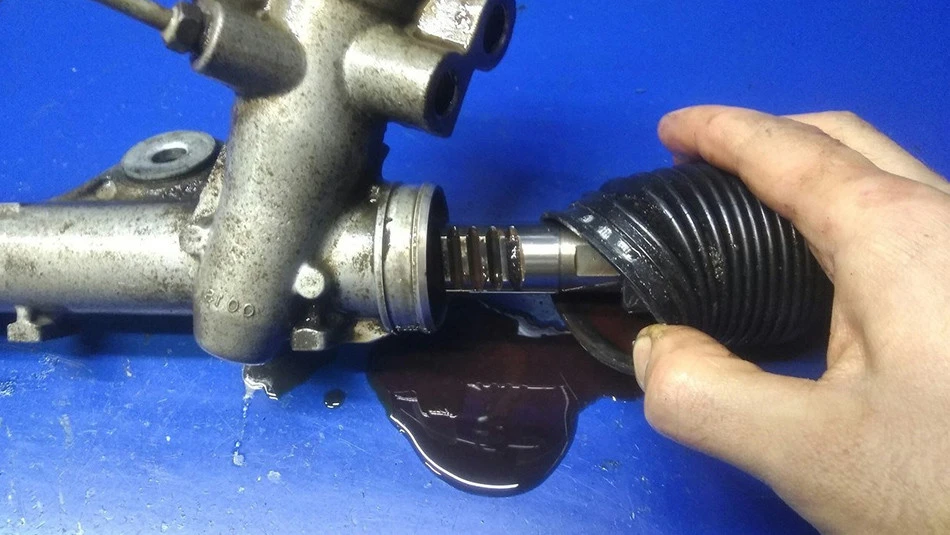
Hydraulic steering racks depend on seals that hold pressure while the rack shaft moves side to side. When those seals wear, fluid may collect inside the rubber bellows boots or drip near the inner tie rod area. The puddle often shows up under the front half of the vehicle, not directly under the engine oil pan.
A power steering fluid leak may look amber, red, pink, or brown depending on the vehicle and fluid age. Fresh fluid often feels slick between your fingers, while old fluid can look dark enough to confuse with engine oil. The location matters more than color alone, because splash and wind can move fluid across shields and brackets.
The counterintuitive part is that a dry driveway does not clear the rack. Underbody panels can catch fluid for weeks. A shop may need to remove a splash shield or pull back a boot to find the dampness that never made it to the pavement.
Why noise during turns can point away from the rack
A whining sound while turning often points to low fluid or a strained pump. A groan at full lock can happen when the system reaches pressure limits. A clunk over bumps may come from suspension joints instead of the rack housing. Noise helps, but it rarely solves the case by itself.
Rack trouble becomes more likely when noise arrives with other clues. If the steering feels uneven, the fluid level keeps dropping, and one rack boot looks swollen or wet, the pattern gets harder to ignore. One symptom whispers. Three symptoms start talking.
Shops in the U.S. also see seasonal patterns. Cold mornings can thicken old fluid and make a weak system complain. Summer heat can make tired seals seep faster. Temperature does not create the original wear, but it often reveals it at the worst time.
How Fluid Leaks, Wear, and Road Feel Connect
Steering problems feel personal because your hands touch the evidence all day. The rack sits low in the vehicle, taking vibration, road splash, heat, and constant movement. Once wear begins, fluid loss and poor steering feel can feed each other until the whole system starts acting tired.
How seal wear turns into bigger steering damage
Rack seals do not fail only because a vehicle is old. Contaminated fluid, torn boots, rust on the rack shaft, and long periods of low fluid can speed up the damage. Once fluid leaks out, the pump may pull air, the assist may become uneven, and the driver may feel stiff spots during slow turns.
A power steering fluid leak also creates a money trap. Some drivers keep topping off the reservoir without asking where the fluid went. That can buy time, but it can also hide a worsening failure until the pump begins making noise or the rack starts binding.
There is a practical rule here: if the reservoir drops again after being filled, the system needs inspection. Fluid does not disappear as part of normal operation. It leaves through a leak, and the rack is one of the places that can cost the most if ignored.
When uneven road feel points to internal rack wear
A worn rack can feel different depending on steering angle. The center may feel loose, then the wheel may tighten as you turn farther. In other cases, the assist may feel stronger in one direction than the other. That uneven feel can come from internal wear, pressure issues, or mechanical binding.
Loose steering feel becomes more serious when the vehicle no longer tracks cleanly after a turn. You may exit a corner and feel the wheel settle late, or the vehicle may need a small correction to keep going straight. That is not normal driver fatigue. That is feedback worth respecting.
The surprise for many owners is that tire wear can join the story late. A worn steering rack may let the wheels move slightly off their intended path, and the tires pay for that movement. By the time the tread shows feathering or odd edges, the steering fault may have been building for months.
Repair Decisions That Save Money and Protect Control
The right repair depends on proof, not fear. Some vehicles need hoses, fluid service, tie rods, or pump work before anyone talks about a full rack. Others show enough leakage, internal play, or binding that delaying the job only raises the final bill.
How to confirm the fault before approving rack work
A good inspection starts with the simple items. Tire pressure, tire condition, fluid level, belt condition on older systems, visible hose leaks, and outer tie rod movement all need attention before the rack gets blamed. Skipping those checks is how owners pay for expensive parts without fixing the problem.
The shop should inspect the rack boots, inner tie rods, mounting bushings, hoses, and pump operation. A technician may also check for looseness while another person moves the steering wheel slightly back and forth. That small movement can reveal whether the delay comes from the rack, linkage, or suspension.
Drivers should ask direct questions. Where is the leak? Is the boot wet inside? Is there inner tie rod play? Does the rack bind, or is the main issue external? Clear answers build trust, and vague answers deserve a second opinion.
When rack and pinion replacement is the smarter repair
A rack that leaks from internal seals, binds during turns, or has confirmed internal play often needs replacement rather than patchwork. Stop-leak products may soften seals for a short period, but they do not repair worn metal, damaged boots, or contaminated fluid. They can also create false confidence.
Rack and pinion replacement usually comes with related work. Many vehicles need fresh fluid, new outer tie rods if worn, and an alignment afterward. That alignment is not a bonus service. It is part of returning the steering geometry to a safe, predictable setting.
Costs vary across the USA because labor rates, vehicle layout, parts quality, and rust exposure change the job. A compact sedan in Arizona may be a cleaner repair than a salt-belt crossover in Ohio with seized hardware. The cheapest quote is not always the best one if it skips alignment or uses weak parts.
Conclusion
Bad steering rarely fails in a single dramatic moment. It usually teaches you to adapt first. You hold the wheel tighter, correct the lane drift, ignore the damp spot, and tell yourself the vehicle has always felt a little loose. That habit is expensive, and it is not worth defending.
The smarter move is to treat rack and pinion symptoms as an early warning system. Check the fluid level, look for wet boots, notice changes in steering response, and get the front end inspected before the problem spreads into tires, pump strain, or unsafe control. You do not need to become a mechanic to protect yourself. You need to stop normalizing bad feedback from the one system that tells the vehicle where to go.
Schedule a proper steering inspection at the first clear sign of looseness, leaking, or uneven assist, because confident steering is not a comfort feature. It is the line between control and luck.
Frequently Asked Questions
What are the first signs of a bad rack and pinion?
Early signs often include looseness in the steering wheel, uneven steering effort, fluid near the front underbody, clunking during small corrections, or wandering on smooth roads. The strongest clue is a pattern of symptoms rather than one isolated noise or drip.
Can I drive with steering wheel play?
Minor looseness may let the vehicle move, but it should not be ignored. Extra play reduces precision during lane changes, emergency corrections, and wet-road driving. A shop should inspect the rack, tie rods, and suspension before the looseness gets worse.
How do I know if my steering rack is leaking?
Look for slick fluid near the front of the vehicle, damp rack boots, falling power steering fluid level, whining during turns, or oily residue around inner tie rod areas. A dry driveway does not rule it out because shields can hold leaking fluid.
Does a bad rack and pinion make noise?
It can, but noise alone does not prove the rack is bad. Whining may come from low fluid or pump strain, while clunks can come from tie rods, bushings, or suspension parts. Noise matters most when paired with looseness or leaking.
Is rack and pinion replacement worth it on an older car?
It depends on the vehicle’s condition, value, and repair history. Replacement makes sense when the engine, transmission, tires, and body are still solid. It may not make sense if the car needs several major repairs at the same time.
Can low power steering fluid cause loose steering?
Low fluid can cause hard steering, noise, uneven assist, and poor response. It does not always create true mechanical looseness, though. If the fluid keeps dropping, the leak needs to be found before the pump or rack suffers more damage.
What else feels like a worn steering rack?
Bad tie rods, worn ball joints, loose control arm bushings, poor alignment, damaged tires, and steering shaft play can all mimic rack trouble. That is why a full front-end inspection matters before approving major steering work.
How soon should I fix a rack and pinion leak?
A confirmed leak should be handled as soon as practical, especially if the fluid level drops or steering feel changes. Waiting can damage the pump, worsen control, and raise repair costs. Loss of steering assist can turn a routine drive into a serious risk.